Independent artists in 2026 aren’t competing for “talent.” They’re competing for attention, and attention is managed by platforms. If your music isn’t being heard, it’s rarely because the track isn’t strong. It’s because your promotion isn’t reaching the right listeners consistently enough to create momentum.
The music industry is also more polarized than ever. On one side, you have major labels running massive release campaigns. On the other side, you have independent artists trying to do everything with limited time, limited budget, and a lot of noise in the middle.
That middle is where most artists get stuck. They post a link, get a small spike, and then the spike collapses. They try paid ads, but the ad spend feels wasted. They try playlist push services, but the results don’t convert into real fans.
This guide is built to fix that. It’s a comprehensive, data-informed approach to music promotion for independent artists in 2026, focused on real listeners, sustainable growth, and strategies that carry into future releases.
You’ll learn how to structure a release strategy, how to use pre-save campaigns correctly, how to pitch playlist curators without spam, how to build streaming links that convert, and how to avoid fake streams that destroy trust.
The biggest shift is that discovery is now multi-channel by default. Your new music might be discovered through short-form video, a YouTube channel, a niche playlist, or a fan community before it ever hits a mainstream audience.
Streaming platforms are also better at filtering low-quality signals. If your growth comes from passive listening or suspicious traffic, your reach often shrinks over time, even if the streams looked good for a week.
That means modern music promotion isn’t “get exposure.” It’s getting quality engagement that platforms can safely expand.
Most independent artists still treat Spotify like a lottery ticket. They chase playlist placements and hope the algorithm blesses them.
In 2026, Spotify is closer to a testing system. It measures listener behavior, then expands distribution when the data is strong. Weak data leads to a shrinking distribution.
So the goal is not just playlist consideration. The goal is consistent engagement signals that tell Spotify your track deserves more listeners.
If you want predictable growth, your promotion needs three outcomes. You need a discovery that brings in new listeners. You need a conversion that turns listeners into followers or savers. You need retention that keeps them coming back.
Most artists only do the first part. They get discovered once, then disappear. That’s why their music career feels unstable.
A sustainable music career is built when your promotion keeps working after the first week.
The best campaigns start before release day. Not because “hype” is magical, but because you’re building an audience wave that shows up when the track goes live.
A release strategy should include content, outreach, and conversion steps that are ready in advance. That preparation creates clean early engagement signals.
If you start promotion after the release drops, you waste the most valuable testing window.
A release campaign is not one post. It’s a sequence that moves people from awareness to listening to saving.
That sequence should last weeks, not hours. It should include multiple content formats, not one repetitive message.
When you build campaigns that compound, you stop restarting from zero with every upcoming release.
Pre-save campaigns can help, but only when they come from real intent. If you collect pre-saves from random traffic, you inflate a number without building listening behavior.
The best pre-save campaigns target your existing audience and warm listeners. These are the people most likely to listen on release day and generate meaningful engagement.
A pre-save should be a promise of listening, not a click for vanity.
The first week matters because it’s the cleanest dataset. Spotify for Artists will show you how your track performs early and whether the platform expands distribution.
Early engagement is not about “stream count.” It’s about saves, completion rate, repeat listening, and playlist adds from engaged listeners.
If you win the first week, you increase your probability of algorithmic lift later.
Playlist placements still matter because playlists create structured listening sessions. A listener in a playlist is already in “music mode,” which increases the chance of saving and returning.
But not every playlist placement is a win. Low-quality playlists can produce passive listening that does not build fans.
Your goal is legitimate playlists that generate real listener behavior.
Spotify playlist curators are not all the same. Some curate for audiences. Some operate “playlist networks” with unclear traffic sources.
Your job is to find curators who protect the listener experience and update consistently. These curators tend to drive better engagement quality.
A good curator placement often converts better than a “bigger” placement with passive listeners.
Independent playlist curators usually have a theme, a niche, and a listening community. Random playlists often have mixed genres, irregular updates, and unclear audience intent.
When your track lands in random playlists, your audience data gets messy. Messy data reduces algorithm confidence.
In niche genres, relevance beats scale almost every time.
Playlist outreach fails when artists send the same generic message to every curator. Curators can see it instantly.
A good outreach message references the playlist’s mood, genre focus, or similar artists already included. It makes the curator feel understood.
When you pitch like a professional, you get more responses and better placements.

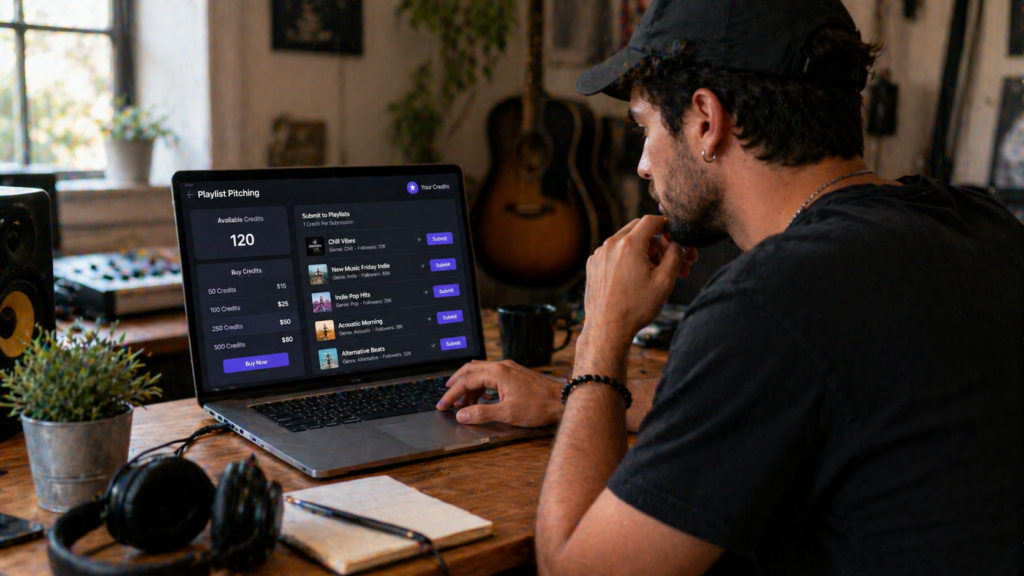
A playlist pitching platform can be a helpful, accessible entry point for new artists, especially when it connects artists to relevant playlists.
But platforms vary. Some are transparent and quality-focused. Others are closer to “playlist push” marketplaces that prioritize volume.
If a platform cannot explain how it vets playlists, you’re exposed to low-quality playlist placements.
Some services use a credit-based system called “credits,” where artists purchase credits to submit music to curators. This model can be legitimate when the curator network is real, and submissions are filtered.
The risk is when credits become a pay-to-play funnel that attracts bad playlists. If artists purchase credits but the traffic is low-intent, the campaign becomes expensive and ineffective.
If you use a credit-based system, track performance aggressively, and prioritize curators who produce real fans.
Unreleased music can be pitched, but it needs structure. Curators need easy access, a clear release date, and confidence that the track is real and finalized.
Spotify editorial playlists require pitching through Spotify for Artists before the release date. That is a separate lane from independent playlist outreach.
If your unreleased music is not ready, don’t pitch it. Weak execution reduces future playlist consideration.
Editorial playlists are curated by Spotify’s editorial team. You cannot DM editors, and you cannot buy editorial placement.
Your leverage is Spotify for Artists, pitching, accurate metadata, and a release strategy that supports early engagement.
Editorial placements can drive exposure, but performance still determines whether the exposure converts.
Algorithmic playlists are where scale happens. Discover Weekly and Release Radar are driven by listening patterns, not outreach.
You trigger algorithmic playlists with consistent engagement signals: saves, completion rate, repeat listening, and stable retention metrics.
The platform expands distribution when the data proves fit.
To trigger algorithmic playlists, you need targeted listeners, not random listeners. Random traffic creates skip-heavy sessions and lowers engagement quality.
When listeners engage, Spotify interprets your track as valuable. That leads to algorithmic recommendations and a deeper reach.
Algorithmic growth is earned, not requested.
Spotify for Artists is where you monitor playlist activity, audience trends, and artist insights. It’s also where you spot red flags early.
If you see streams without saves or spikes without follower growth, your traffic may be low quality. That matters because it can weaken future releases.
Use Spotify for Artists weekly, not monthly. Data is only useful when it’s timely.
Many artists lose listeners because the path to listening is confusing. Streaming links should be simple, fast, and mobile-friendly.
A clean link flow helps you capture intent during the release window. It also helps you track which channels drive clicks.
If your link experience is messy, you waste the attention you already earned.
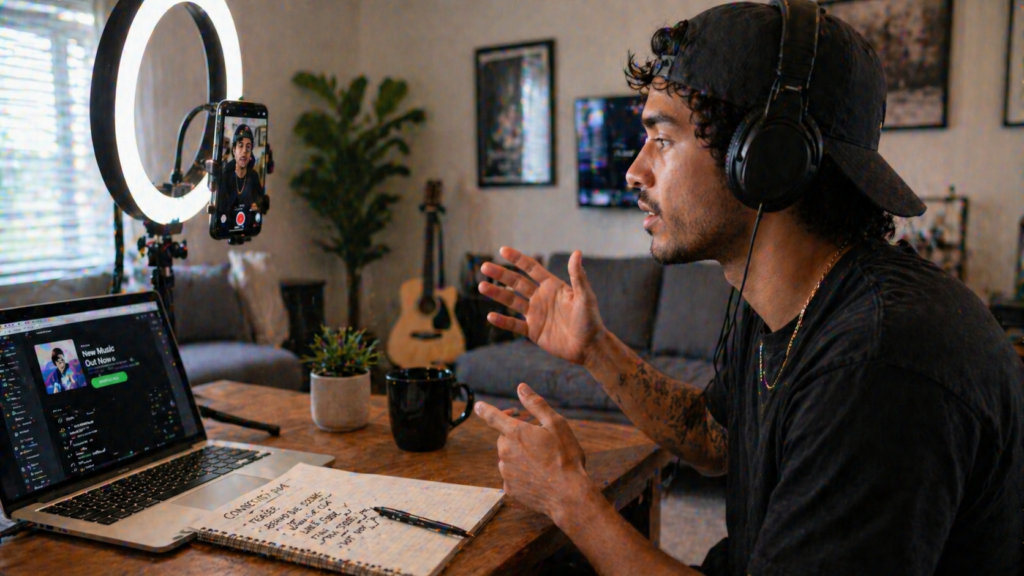
Social media marketing works when it creates listening intent, not just likes. The goal is to build curiosity that can only be satisfied by listening.
Short-form video is the fastest discovery tool because it’s distributed aggressively. But it must match your sound and target audience.
If your content attracts the wrong crowd, your Spotify data becomes weaker.
Short-form video gives you repeated exposure. Repeated exposure creates familiarity. Familiarity increases listening conversions.
The key is repetition with variation. Use multiple hooks, multiple angles, and multiple formats around the same track.
One viral clip is nice. A consistent content loop builds a sustainable career.
YouTube channels can build long-term discovery because content is searchable and evergreen. Music videos, lyric content, and behind-the-scenes footage can keep working for months.
YouTube Music also captures listeners who prefer YouTube as their main streaming service. That matters across different platforms.
If you want durable music discovery, YouTube is a strategic layer, not an optional one.
A music video is no longer a single upload. It’s a content engine that can produce short clips, story edits, and promotional content for weeks.
Even simple videos can work if the concept matches the sound. Visual alignment improves retention, which improves conversions.
When visuals and music fit together, your campaign looks professional and performs better.
Behind-the-scenes footage builds a connection. It turns listeners into participants.
When fans feel included, they engage more. Engagement creates stronger signals across platforms.
Fan communities are built through consistent relationship building, not through one post.
Direct outreach can include blogs, radio stations, and industry professionals. These channels still matter, but they are support layers, not the whole plan.
Music blogs can provide credibility and search visibility. Radio placements can help in certain genres and regions. Industry professionals notice consistency.
Outreach works best when your artist brand is clear, and your materials are ready.
Press coverage is most valuable when it reaches your target audience and supports credibility. Random press rarely moves the needle.
Pitch blogs that cover your niche genres. Reference similar artists and show why the track matches their readers.
A clean press approach builds long-term marketing success without wasting effort.
Radio stations still influence certain audiences, especially outside major urban markets. For some genres, radio placements can create real listening habits.
But radio is rarely the primary engine for indie growth. Treat it as an amplifier when it fits your audience.
If radio doesn’t match your market, don’t force it.
Paid ads can work, but only when they amplify what already converts. Most wasted ad spend comes from sending cold listeners directly to a track with no context.
A better approach is content-first. Promote a strong short video, then send interested users to streaming links.
Paid advertising should be measured by saves, followers, and retention—not only streams.
YouTube ads can work well for longer-form storytelling and music video previews. Social media ads can work well for fast hook testing.
Both require targeting discipline. If your target audience is too broad, you buy low-quality attention.
A data-driven decision framework keeps your ad spend clean and effective.
Retargeting is how you convert people who have already shown interest. A custom audience lets you focus on warm listeners instead of buying cold traffic repeatedly.
Warm listeners convert better. They are more likely to save, follow, and replay.
This is one of the most cost-effective tools for independent artists with a limited budget.
Vanity metrics make you feel good. Engagement quality makes you grow.
High engagement quality means listeners stay, save, and return. Low engagement quality means streams that disappear.
Spotify's growth in 2026 is driven by quality engagement, not inflated numbers.
Fake streams inflate raw numbers but destroy trust. They create patterns that Spotify can detect and filter.
Even if you avoid penalties, you lose the most important thing: clean data. Without clean data, you cannot improve strategy.
A sustainable music career requires real listeners, not artificial spikes.
Some services promise “guaranteed feedback.” That can be valuable if the feedback is real, relevant, and connected to legitimate playlists.
But many guaranteed feedback claims are low-value responses that do not improve your strategy. Feedback is only useful when it helps refine release campaigns and targeting.
Measure feedback by results, not by the promise.
Brand partnerships can accelerate reach when the brand audience matches your music. Partnerships also add credibility and can support revenue beyond streams.
But partnerships require clarity. Brands need to understand their identity and audience.
If you build your artist brand correctly, partnerships become easier to earn.
Live performance converts listeners into fans faster than almost anything. Ticket sales are also a revenue layer that stabilizes your music career.
Even small gigs can create core fan communities. Those communities become your first-wave listeners for new releases.
Live performance is not separate from promotion. It is a promotion with emotional depth.
Most independent artists fail because they improvise. They do bursts of promotion, then disappear.
A sustainable career comes from repeatable systems: consistent releases, consistent content, consistent outreach, and consistent learning.
When you build systems, future releases perform better because you don’t start from zero.
A data-informed approach means you track what works and repeat it. It doesn’t mean you obsess over every number.
Watch what sources drive real listeners. Watch what content produces saves. Watch what playlists produce retention.
Then refine. Each campaign is a learning cycle that makes your next campaign stronger.
You do not need a huge budget to grow. You need disciplined execution.
Start with a small set of relevant playlists. Start with a simple content loop. Start with a clear release strategy.
Then scale what works. Scaling before validation is how artists waste resources.
Explicit Promo focuses on organic growth: real listeners, real engagement, and playlist promotion that prioritizes legitimate playlists and sustainable results.
We avoid playlist push tactics, fake streams, and low-quality placements that create passive listening. We emphasize targeted outreach, data-driven decisions, and campaigns built for retention.
If you want music promotion that carries into future releases, you need a strategy and execution designed for long-term momentum.
Music promotion for independent artists in 2026 is not about doing everything. It’s about doing the right things consistently.
Build a release strategy that wins the first week. Use pre-save campaigns that translate into listening. Pitch relevant playlists through real curators. Use short-form video to drive discovery. Use paid ads to amplify what already works. Track engagement quality so your growth compounds.
When you focus on real listeners and sustainable systems, your music gets heard more often, your audience grows cleaner, and your career becomes more predictable.
Ready to grow your streams the right way? Contact Explicit Promo today and start building real momentum for your music.
