Advertising used to be “outside” the music industry. It was something brands did, while artists focused on making music and labels handled distribution.
That world is gone.
In 2026, advertising sits inside the discovery engine itself. The TikTok app decides what short-form videos get seen. Spotify decides what tracks get recommended through personalized playlists. Both systems are powered by algorithms, and both systems monetize attention through advertising revenue and subscription economics.
That shift has changed the path from new music to a wider audience. It has also changed how revenue growth happens across music streaming, how rights holders get paid, and why independent labels are building strategic partnerships instead of relying on traditional gatekeepers.
For artists, this is not just “platform news.” It is a practical reality. If you don’t understand how advertising influences music discovery, you will misread your own growth. You will chase the wrong metrics. You will celebrate views that never become listeners.
This guide explains how TikTok and Spotify changed music streaming models, how short videos drive listening habits, and how artists can build campaigns that convert attention into real fans—without shortcuts, without bot traffic, and without damaging long-term momentum.
Advertising is no longer just a way to “promote.” It is how platforms organize consumer attention.
TikTok’s algorithm is built to keep people watching. Spotify’s algorithm is built to keep people listening. Both monetize those sessions differently, but the mechanics are similar: predict what users want, deliver it fast, and keep them inside the platform.
That means music discovery is increasingly shaped by what platforms can distribute efficiently. Advertising becomes the tool that amplifies distribution, tests content, and expands reach beyond organic limits.
For artists, the result is a new reality. You don’t just need good songs. You need a system that can survive algorithmic shifts, convert new users into real listeners, and build durable audience growth across other platforms.
TikTok didn’t just add a new channel. It created a new default behavior: short videos as the first touchpoint for songs.
Years ago, discovery happened through radio stations, blogs, and curated playlists on streaming services. Today, millions of consumers hear music for the first time inside a 7–20 second loop, often attached to stories, games, memes, and trends.
That has altered listening patterns. People don’t always discover new music by searching for it. They discover it while watching content, reading comments, and following creators.
When a sound becomes attached to a format, it gains global reach. That reach can create massive spikes in “awareness,” but awareness is not the same as conversion. The difference is where advertising enters the picture.
Spotify’s model is built around sessions and retention. A user comes to listen, not to watch. Spotify monetizes through premium subscribers and ad-supported listening, which means it can earn revenue even when the user is not paying directly.
That hybrid model matters for music discovery. On the free tier, Spotify has strong incentives to keep the user engaged because ads pay for attention. On the paid tier, Spotify has incentives to keep subscribers satisfied because churn kills revenue growth.
So Spotify’s algorithm tends to reward tracks that create consistent listening habits. The platform measures whether listeners return, save, replay, and finish songs. Those behaviors are the raw material of personalized playlists like Discover Weekly.
TikTok can create the spark. Spotify decides whether the spark becomes a listening routine.
TikTok is often the “hook.” Spotify is often the “habit.” Advertising is what makes the loop scalable.
A short video creates attention. Advertising expands that attention faster than organic reach alone. People hear a sound, use it, share it, and spread it to a wider audience.
Then the listener moves to Spotify. If the track fits their taste and creates engagement, Spotify expands distribution through personalized playlists. That creates more listeners, more sessions, and more opportunities for ad-supported monetization.
When the loop works, both platforms benefit. TikTok keeps users watching. Spotify keeps users listening. Rights holders get paid through streaming revenue. Artists gain new audiences.
When the loop breaks, you get views without streams. You get streams without fans. You get growth without stability.
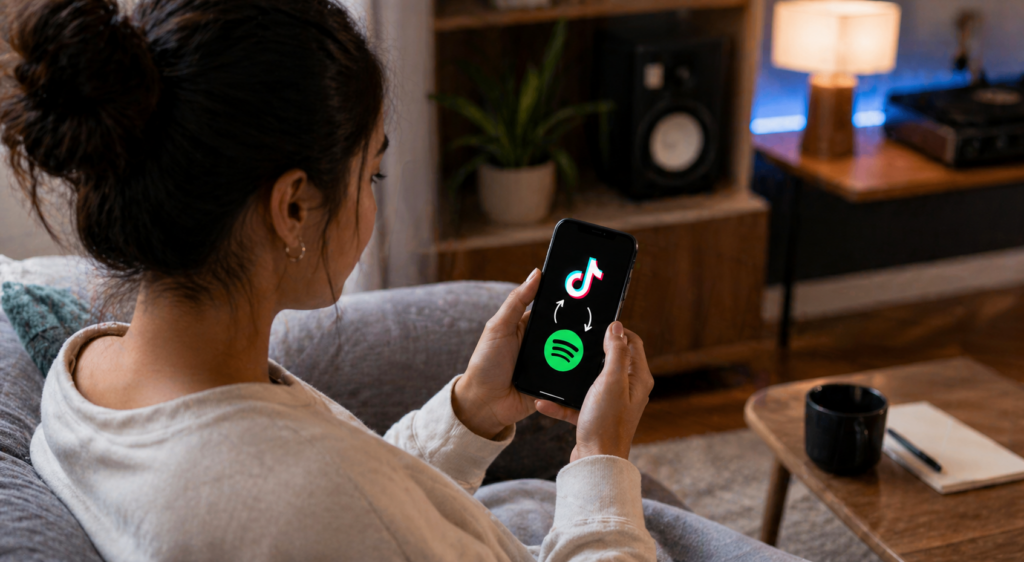
A TikTok view is often passive. A Spotify stream is slightly more intentional. Neither guarantees real interest.
In the modern music industry, creators see 200k views on a TikTok app post and assume success. Then Spotify barely moves, and they feel confused. The confusion comes from treating attention as conversion.
TikTok can distribute a sound to people who like the format, not necessarily the music. Spotify will then see that traffic as low-intent. Low-intent traffic increases skips, lowers completion rate, and weakens the probability of algorithmic recommendations.
Advertising can amplify both success and failure. If your creative is aligned, ads expand to the right audience. If it’s misaligned, ads expand to the wrong audience faster.
Revenue growth in music streaming is driven by two engines: subscriptions and advertising. That’s true across Spotify, and it’s increasingly relevant across other platforms.
Premium subscribers generate predictable subscription revenue. Ad-supported listening generates variable advertising revenue. The balance between these engines shapes how platforms invest in discovery.
Platforms are incentivized to keep new users engaged, whether they pay or not. That means they need content offerings that create repeat sessions. Music works because it is high-frequency content. People listen daily. That daily behavior is highly monetizable.
For artists, this means attention is valuable, but only when it becomes repeat listening.
Rights holders care about scale, but also about control. The streaming era shifted power toward platforms, and rights holders responded by renegotiating how value flows.
Independent labels have grown significantly in recent years because the distribution landscape has become more accessible. They can build strategic partnerships with platforms, creators, and marketing teams without needing the same infrastructure as major labels.
This has influenced advertising too. Labels and rights holders increasingly treat advertising as an essential layer, not a “nice to have.” They invest in targeted efforts that accelerate discovery and help songs capture wider audience attention while maintaining engagement quality.
For artists, the implication is clear: campaigns are professional now, even at smaller scales.
Personalized playlists are one of the biggest reasons Spotify still dominates music discovery.
Discover Weekly is not a playlist in the traditional sense. It is a recommendation engine that uses listening history, listening habits, and patterns across millions of users. It tests songs in clusters and expands distribution when the track performs.
That performance is behavioral. Spotify measures what users do, not what artists claim. If listeners skip, Spotify stops pushing. If listeners save and replay, Spotify expands reach.
Advertising can accelerate the first wave. But personalized playlists decide long-term lift.
TikTok’s design rewards participation. A sound is not just listened to. It is used.
When a sound becomes part of a trend, it gains distribution through repetition. Repetition builds familiarity, and familiarity drives curiosity. That curiosity becomes “go find this song,” which creates a bridge to streaming services.
The comments section matters more than many artists realize. Comments reveal intent. If people ask for the song name, they are ready to listen. If they only comment on the joke, they are entertained but not converted.
Advertising boosts this dynamic by pushing content to more people faster.
Most artists run ads like a megaphone. They try to reach more people.
That is not the point. The point is to reach a specific audience likely to become a listener. Your target audience should match your genre, mood, and content identity.
If you run ads broadly, you will generate clicks that don’t convert. That creates weak engagement on Spotify. Weak engagement tells Spotify the track is not worth expanding.
Advertising is only powerful when it is targeted and measured. The platform economy is not forgiving to low-quality traffic.

Spotify's growth is commonly measured by raw stream counts. That’s the wrong approach for long-term success.
Streams can rise for reasons that don’t build a fanbase. Playlist push tactics, low-quality playlist networks, or misaligned TikTok exposure can inflate numbers without creating saves or followers.
Spotify interprets growth as retention and satisfaction. If listeners don’t come back, Spotify doesn’t treat the track as valuable.
So the right approach is not “how many streams.” The right approach is “how many engaged listeners did we earn?”
The most important signals are behavioral. Save rate, completion rate, repeat listening, follower growth, and playlist adds to personal playlists are strong signals of genuine interest.
When these move together, Spotify becomes more confident. Confidence leads to algorithmic recommendations. Recommendations lead to growth.
TikTok can influence these metrics indirectly by sending traffic. But Spotify decides whether that traffic is useful. Advertising can shape who that traffic is.
That is why data is not optional. It is the only way to separate hype from real audience growth.
Premium subscribers matter because they represent predictable revenue. Spotify invests heavily in keeping premium users satisfied because churn kills growth.
That makes listening habits a core asset. If your music becomes part of someone’s routine, it is highly valuable to the platform. It keeps users listening, which supports retention and subscription value.
Advertising can help create the first exposure. But habit is what keeps the listener. That is why playlists, saves, and repeat sessions matter more than short spikes.
Habit is the hidden driver of sustainable music careers in streaming.
TikTok can deliver global reach quickly. Spotify can then show streams from countries you never targeted. That can feel like success.
But geography without coherence can be a red flag. If the traffic doesn’t match your language, genre, culture, or marketing efforts, it may not convert. It may also reflect low-quality distribution networks.
Real international growth tends to follow patterns. It shows up alongside consistent engagement and follower growth. It also often correlates with specific creators or trends.
A strong strategy uses geographic data to learn, not just to celebrate.
Spotify’s growth is not only in music. Podcasts and other offerings are part of how Spotify keeps users inside the app. TikTok’s growth is not only music, either. Stories, games, and formats shape user time.
Why does this matter for music discovery? Because content offerings compete for attention. If users spend more time on podcasts, they may spend less time on playlists. If users spend more time watching, they may spend less time searching for new music.
Platforms will continue balancing these experiences to maximize revenue. Artists need to adapt by integrating music into the formats where attention is growing.
Short-form videos remain the strongest bridge, but not the only one.
Artists should use advertising for two goals: reach the right audience and measure what converts.
The first goal requires targeting. You need to know what audience you want: genre, mood, geography, and content identity. You also need to know what you don’t want: broad clicks that skip quickly.
The second goal requires measurement. You need to track what happens after the click. Do listeners save? Do they follow? Do they return? Do they explore other songs?
Advertising without measurement becomes money spent without learning. That is not sustainable.

TikTok can increase Spotify streams, but conversion depends on audience fit. If TikTok traffic produces saves and strong retention, Spotify expands distribution through recommendations and playlists.
Many trends attract entertainment-focused viewers who don’t become listeners. When they click and skip, Spotify reads weak engagement and reduces further testing.
Spotify’s model combines advertising revenue and premium subscribers, so the platform is incentivized to keep users listening. Tracks that generate strong engagement are rewarded with more distribution.
Personalized playlists like Discover Weekly are driven by listening history and behavior. They scale when your track proves fit through saves, completion rate, and repeat listening.
It’s not mandatory, but it can accelerate discovery when targeted correctly. The key is using advertising to reach the right audience and measuring engagement quality, not buying empty numbers.
TikTok is changing music discovery because it can create attention at scale. Spotify is changing music streaming because it rewards behavior that reflects satisfaction. Advertising sits between them as the accelerator that can amplify either real growth or empty spikes.
If you want Spotify growth in 2026, you must treat discovery as a system. Use short-form videos to attract the right audience. Use clean link flows to capture intent. Use Spotify data to measure engagement quality. Then build repeatable release strategies that create habit, not just hype.
That is how artists win in a market defined by algorithms, revenue models, and attention economics.
Ready to grow your streams the right way? Contact Explicit Promo today and start building real momentum for your music.
